BT40 vs. HSK E50 Spindle Cores: Taper Geometry, Grinding & Balance Requirements
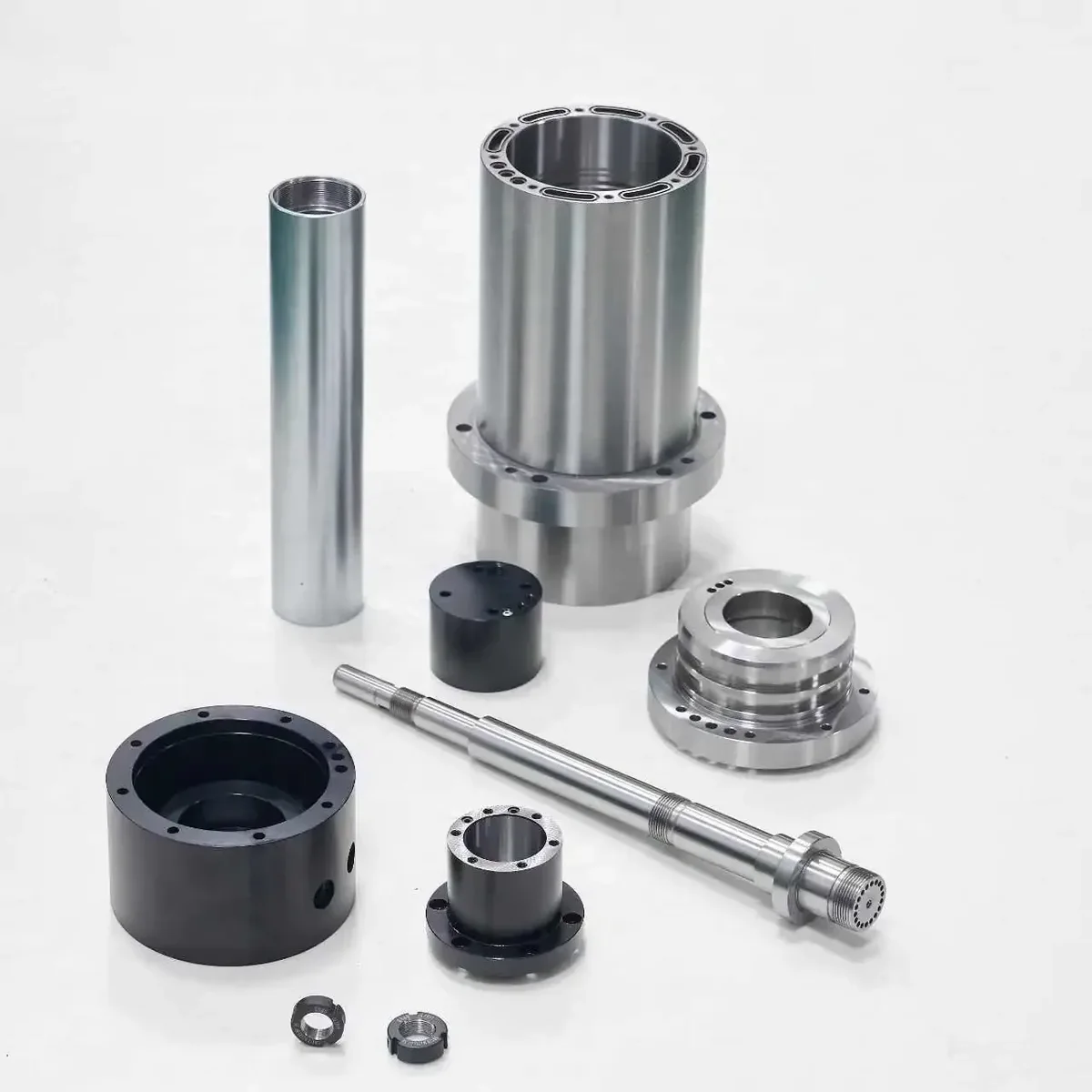
When you're specifying a spindle core for a new machining center or retrofitting an existing one, the interface decision—BT40 or HSK E50—shapes everything downstream. Taper geometry, grinding strategy, balance grade, and even the bearing preload all hinge on that choice. And if you're sourcing an HSK spindle or a BT40 equivalent, you need more than a catalog page. You need to know how the taper is ground, how runout is held to microns, and how balance is verified at speed.
This article breaks down the engineering differences between BT40 and HSK E50 spindle cores, with a focus on what matters to OEM buyers: tolerances, grinding methods, balance requirements, and the factory capabilities that make or break a spindle's performance. We'll keep it technical, but we won't drown you in jargon.
BT40 vs. HSK E50: The Core Geometric Differences
BT40 is a steep-taper interface with a 7:24 taper ratio. The taper angle is fixed, and the tool is retained by a pull stud gripped from behind. HSK E50, by contrast, uses a 1:10 hollow taper with simultaneous face and taper contact. That fundamental difference drives everything else.
With BT40, the taper does the centering and the driving. The flange face doesn't touch the spindle nose—there's a small gap. That means radial location depends entirely on taper contact, which can be compromised by dirt, wear, or thermal growth. HSK E50 closes that gap: the hollow shank deflects elastically under drawbar force, pressing the flange face against the spindle nose. The result is dual contact—taper for centering, face for axial and radial stiffness.
For high-speed applications, this matters. BT40 at 15,000 rpm and above starts to show centrifugal growth at the taper, reducing contact pressure. HSK E50, with its hollow design and face contact, maintains stiffness at higher speeds. That's why you'll see HSK specified for high-speed machining centers and BT40 for general-purpose milling.
Grinding the Taper: Tolerances and Surface Finish
The taper is the heart of the spindle. Get it wrong, and you'll see runout, chatter, and poor tool life. Both BT40 and HSK E50 tapers are typically ground on precision cylindrical or taper grinders, but the requirements differ.
For BT40, the 7:24 taper is ground to a contact pattern of at least 80% along the taper length. Radial runout at the gauge line is typically held to ≤0.002 mm. Surface finish needs to be Ra 0.1 or better to ensure proper contact and minimize wear. At our factory, we grind BT40 spindle cores on Taiwan grinders in a constant-temperature workshop, with final inspection on a German ZEISS CMM with 0.5 μm resolution. That level of metrology is non-negotiable for taper work.
HSK E50 is more demanding. The 1:10 taper must mate with the face simultaneously, so the taper angle and the face runout have to be perfectly synchronized. Any mismatch causes point contact, which kills stiffness and accelerates wear. We grind HSK E50 tapers with in-process gauging and hold radial runout to ≤0.002 mm, with face runout held to ≤0.001 mm. Concentricity between taper and face is critical—we hold it to 0.001 mm.
Surface finish for HSK E50 is also Ra 0.1 or better, but the contact area is smaller, so any waviness shows up fast. We use super-finishing after grinding to eliminate grinding marks and achieve a consistent contact pattern. If you're sourcing a BT40 spindle core, ask for the contact pattern report—it's a quick way to separate serious suppliers from catalog resellers.
Balance Requirements: G1.0 and Beyond
Balance is where high-speed spindles live or die. An unbalanced spindle core generates vibration that destroys bearings, degrades surface finish, and limits speed. Both BT40 and HSK E50 cores need dynamic balancing, but the target grade depends on speed and application.
For BT40 spindle cores, we balance to G1.0 or better at the operating speed. That's typically sufficient for 8,000–12,000 rpm general milling. For HSK E50, especially in high-speed applications, we balance to G0.4 when required. The hollow taper and lighter mass make HSK more sensitive to residual imbalance, so tighter grades pay off.
Balance is verified on a dynamic balancing machine that measures in two planes. We correct by drilling or milling in designated balance lands—never by adding weights that could shift. The process is iterative: balance, measure, correct, re-measure. For OEM buyers, insist on a balance report that shows the grade and the correction method. A spindle that's balanced by grinding the taper is a red flag—it compromises geometry.
Materials, Heat Treatment, and Stiffness
Both BT40 and HSK E50 spindle cores are typically made from alloy steel or bearing steel. For high-speed HSK cores, we often use vacuum-quenched bearing steel to achieve core hardness of 58–62 HRC, with stress relief before final grinding to prevent distortion.
BT40 cores are sometimes made from nitrided alloy steel for a hard case and tough core. The choice depends on load and speed. For HSK E50, the hollow shank needs high fatigue resistance, so we prefer through-hardened bearing steel with a tempered martensite structure. We verify hardness with a Mitutoyo hardness tester at multiple points along the taper and shank.
Stiffness is another differentiator. BT40 has a larger diameter and more mass, giving it high static stiffness—good for heavy cuts. HSK E50 is lighter and more compact, with stiffness that's adequate for high-speed finishing but lower for heavy roughing. If your process mixes both, you might need two spindle types, or you accept compromises. That's a process decision, not a spindle quality issue.
Comparison Table: BT40 vs. HSK E50 Spindle Cores
| Parameter | BT40 | HSK E50 |
|---|---|---|
| Taper ratio | 7:24 | 1:10 |
| Contact type | Taper only | Taper + face |
| Typical radial runout | ≤0.002 mm | ≤0.002 mm |
| Face runout | N/A | ≤0.001 mm |
| Concentricity (taper to face) | N/A | 0.001 mm |
| Surface finish (taper) | Ra 0.1 | Ra 0.1 |
| Balance grade (standard) | G1.0 | G1.0 (G0.4 optional) |
| Max speed (typical) | 12,000 rpm | 20,000 rpm |
| Material (common) | Alloy steel, nitrided | Bearing steel, vacuum quenched |
Note: Values are typical for precision spindle cores from a qualified manufacturer. Actual specifications depend on design and application.
Manufacturing and Inspection: What to Look For
When you're evaluating a spindle core supplier, the manufacturing process tells you more than the spec sheet. For BT40 and HSK E50, the critical steps are taper grinding, balance correction, and final inspection.
At our factory, we grind spindle tapers on Taiwan grinders in a temperature-controlled workshop—typically 20±1°C. That's not marketing fluff; thermal growth in the workpiece and machine can easily exceed the tolerance band if temperature swings. We use a German ZEISS CMM with 0.5 μm resolution for final verification of taper angle, runout, and concentricity. Roundness is checked on a Mitutoyo roundness tester, and hardness on a Mitutoyo hardness tester.
For HSK E50, we also verify the face contact pattern using a blue check. The pattern should be uniform and cover at least 80% of the face area. For BT40, we check taper contact similarly. These are simple tests, but they reveal a lot about process control.
If you need a custom spindle core, we can work from your drawings or samples. Our engineering team reviews the design for manufacturability and suggests tolerances that balance performance and cost. We've made spindle cores for machine tool builders, retrofitters, and high-speed machining applications. If you're not sure which interface fits your machine, contact our engineers—we'll help you sort it out.
FAQ: BT40 and HSK E50 Spindle Cores
Can I replace a BT40 spindle with an HSK E50 spindle in the same machine?
Not directly. The spindle nose, drawbar, and tooling are different. BT40 uses a 7:24 taper and a pull stud; HSK E50 uses a 1:10 hollow taper with face contact and a different clamping mechanism. Retrofitting requires a new spindle unit, tooling, and often machine modifications. It's possible, but it's a project—not a drop-in swap.
What balance grade should I specify for a high-speed HSK E50 spindle?
For speeds up to 15,000 rpm, G1.0 is usually fine. Above that, specify G0.4. The tighter grade reduces vibration and bearing load, which extends spindle life. We balance HSK E50 cores to G0.4 when requested, and we provide a balance report with the correction details.
How do I verify taper contact on a BT40 spindle core?
Use a taper gauge or blue check. Apply a thin layer of marking compound to the gauge, insert it into the taper, and rotate under light pressure. The contact pattern should be even and cover at least 80% of the taper length. If it's patchy or concentrated at one end, the taper is out of spec. We include a contact pattern report with every BT40 spindle core we ship.
Choosing between BT40 and HSK E50 comes down to your speed, stiffness, and tooling requirements. BT40 is robust, widely supported, and cost-effective for general milling. HSK E50 shines in high-speed, high-precision work where face contact and balance matter. Either way, the spindle core's quality—taper geometry, grinding precision, and balance—determines how well it performs. Work with a manufacturer who can show you the numbers and the process. If you're ready to discuss your application, get in touch.
Need a Drawing Review or Sample Quote?
Manufactured directly by Foshan Ruizheng Machinery Manufacturing Co., Ltd. in our ISO 9001:2015 certified, temperature-controlled Foshan, China facility with 70+ CNC turning, milling, and grinding machines and German ZEISS CMM inspection.
Send 2D/3D Drawings for Quote